
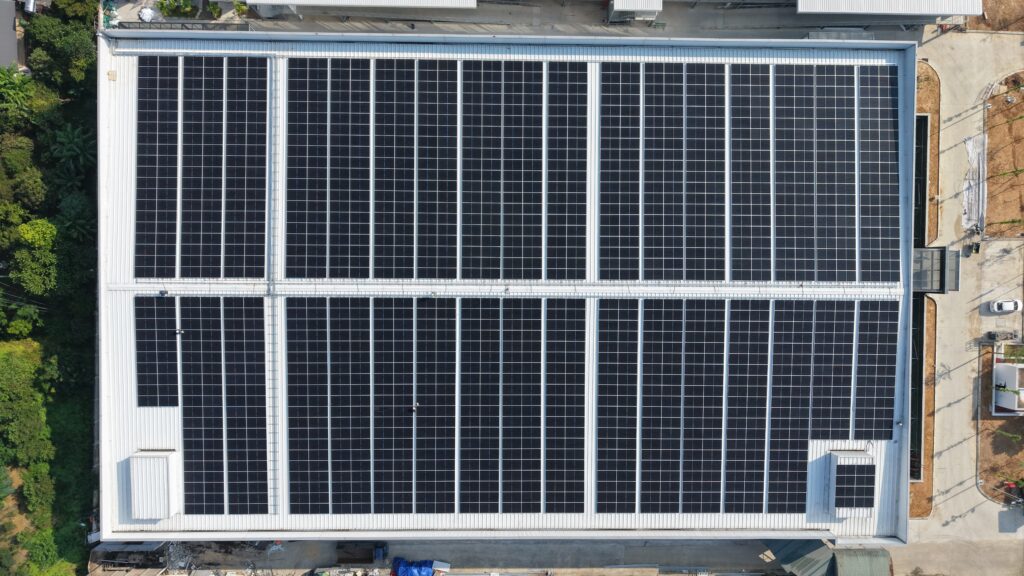
ETEK Power is a rooftop solar and battery storage (BESS) EPC contractor in Vietnam, serving manufacturing plants and industrial parks. ETEK Power handles engineering, procurement, construction, grid connection and maintenance under one contract. Factories can either own the system outright (EPC) or pay nothing upfront and buy the solar power at a discount (PPA).
ETEK Power is a member of Tan Phat ETEK Group, which has operated in Vietnam’s energy and industrial sector for 27 years. This page explains why manufacturers in Vietnam are installing rooftop solar in 2026, what an EPC contractor should deliver, how to choose between EPC and PPA, and which regulations foreign-invested factories need to know.
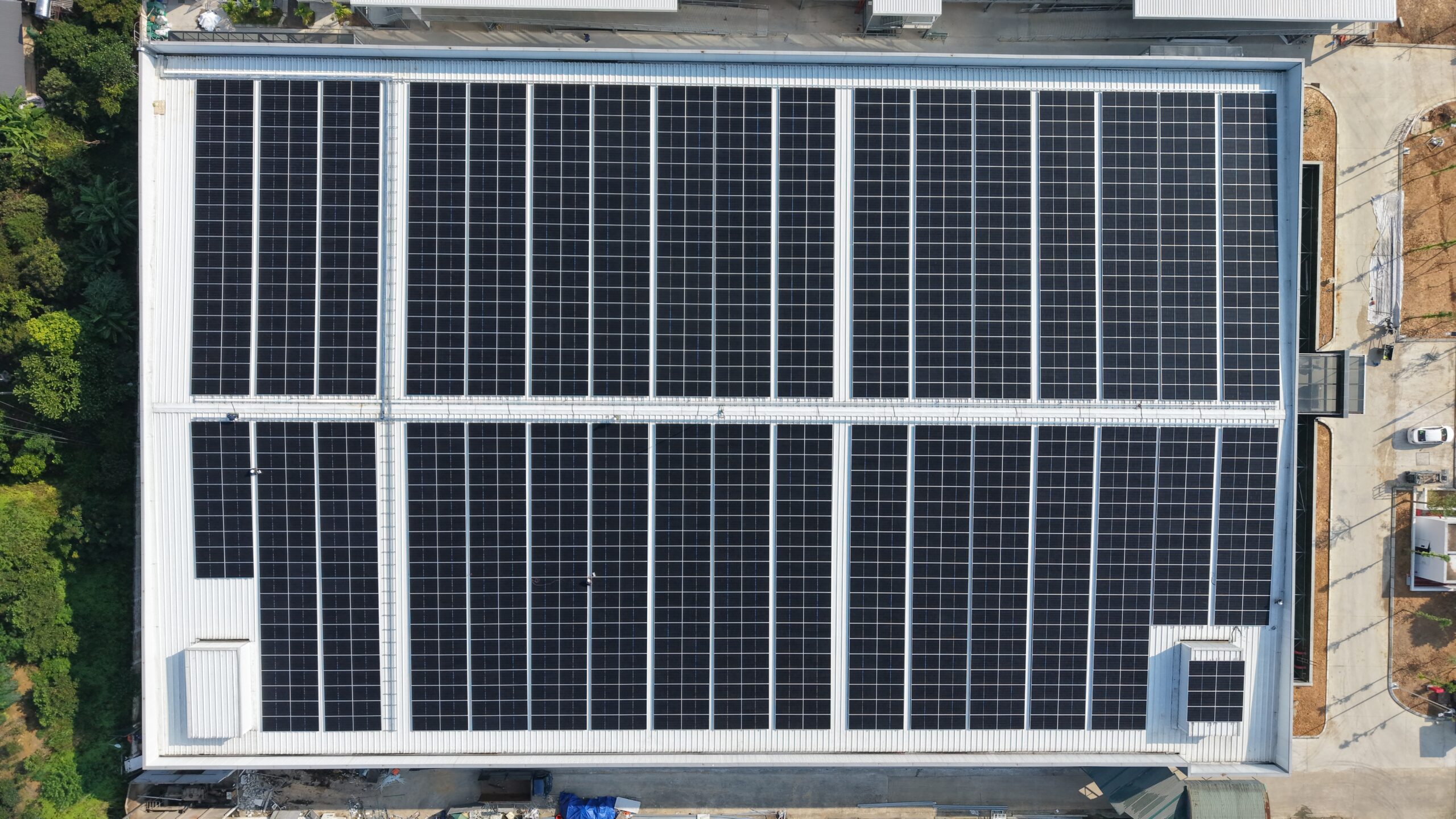
Why are manufacturers in Vietnam going solar in 2026?
Three pressures are pushing factories in Vietnam toward rooftop solar at the same time: higher electricity costs, customer decarbonisation requirements, and new rules that make self-generation more attractive.
1. Electricity costs and new peak hours. Under Decision 1279/QD-BCT, manufacturing customers connected at 22–110 kV pay 1,833 VND/kWh in normal hours and 3,398 VND/kWh in peak hours (before VAT). Since 22 April 2026, the peak window has moved to 17:30–22:30, Monday to Saturday. Rooftop solar produces almost all of its output during normal daytime hours, so every solar kWh used on site directly replaces grid power.
2. Customer and supply-chain requirements. Many global brands have joined RE100 and now ask their Vietnamese suppliers to prove a rising share of renewable electricity. Exporters of steel, aluminium and cement to the EU also face the Carbon Border Adjustment Mechanism (CBAM), where lower indirect emissions help.
3. A more favourable legal framework. Decree 243/2026/ND-CP, effective 26 June 2026, raised the share of surplus rooftop solar power that can be sold to the grid from 20% to up to 50%. It also counts battery-stored solar energy as part of that surplus.
What does a rooftop solar EPC contractor deliver?
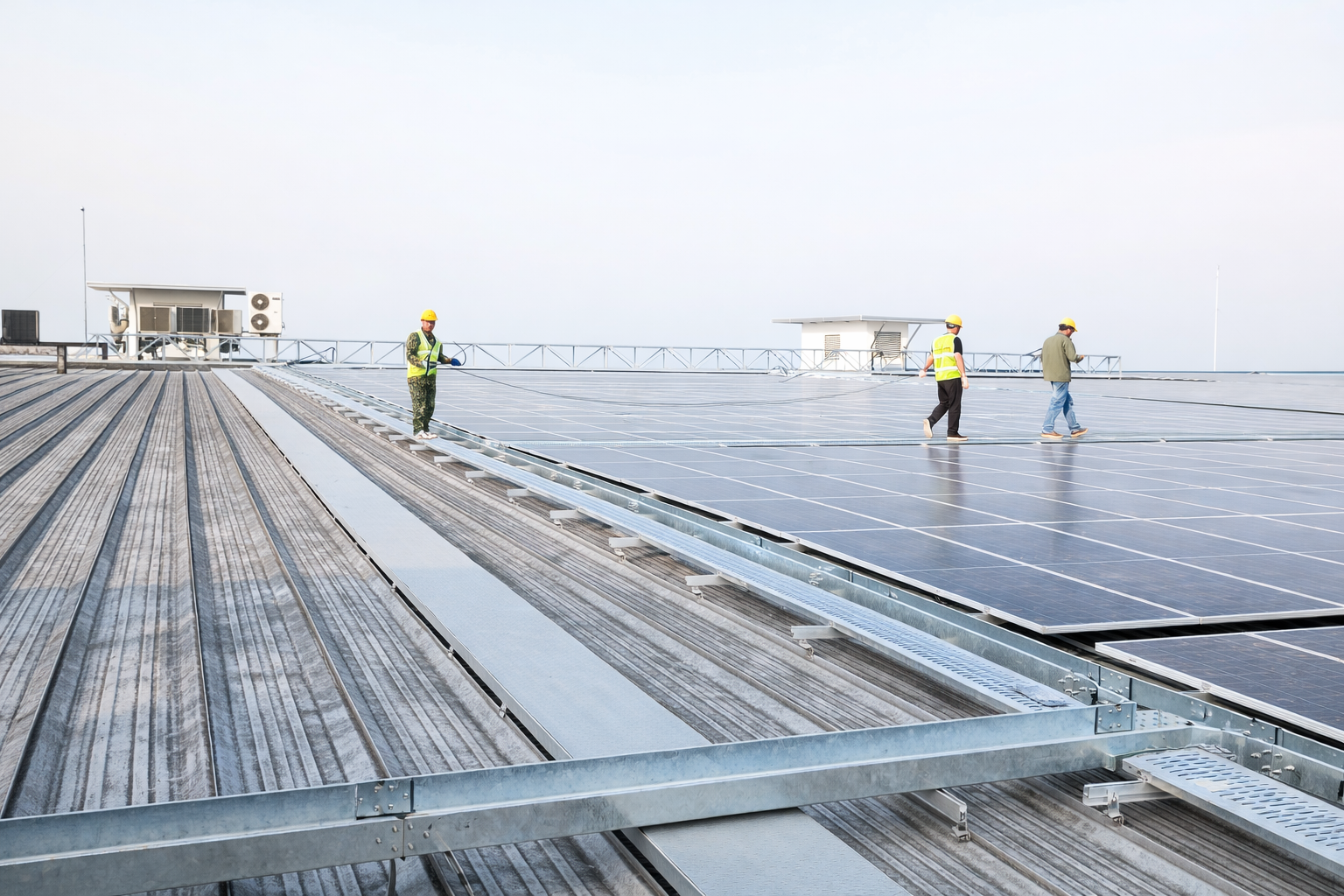
An EPC (Engineering, Procurement and Construction) contractor takes single-point responsibility for the whole project, from roof survey to a system that is connected, tested and producing power. ETEK Power’s scope covers five stages:
| Stage | What ETEK Power does | What the factory receives |
|---|---|---|
| Engineering | Roof and structural survey, shading analysis, load profile analysis, system sizing, electrical design | A system sized to the factory’s daytime demand, not just to the roof area |
| Procurement | Tier-1 solar modules, inverters, mounting and electrical equipment | Equipment with full CO/CQ documents and manufacturer warranties |
| Construction | Installation, cabling, fire safety measures, site safety management | A safe installation that does not disrupt production |
| Commissioning | Testing, acceptance records, grid connection and metering procedures | A system ready for commercial operation, with complete handover documents |
| Operation and maintenance | Monitoring, panel cleaning, preventive maintenance | Stable output over the system’s 20+ year life |
ETEK Power also designs and installs battery energy storage systems (BESS). Because Vietnam’s peak tariff now falls in the evening, adding BESS lets a factory store midday solar power and use it during the 17:30–22:30 peak window.
EPC or PPA: which model fits your factory?
Factories in Vietnam can choose between owning the solar system (EPC) or buying its power under a long-term power purchase agreement (PPA). Both models are available through ETEK Power.
| EPC (self-investment) | Rooftop PPA (zero capex) | |
|---|---|---|
| Upfront investment | Paid by the factory | None – the investor funds 100% |
| Electricity savings | Almost all solar power used on site replaces grid power | Solar power is bought at a discount to the EVN tariff, typically 2–30% depending on region, voltage level and offtake commitment |
| Payback | Typically around 4–5 years | Not applicable – savings start from day one |
| Ownership | Factory owns the system and its full output | Investor owns the system during the contract; buy-out or extension at the end |
| Contract term | Not applicable | Typically 15–20 years |
| Operation and maintenance | Factory’s responsibility, usually through an O&M contract | Covered by the investor for the full term |
| Renewable energy certificates (I-REC) | Belong to the factory | Must be assigned in the contract |
A rule of thumb: factories with available capital and a long-term site usually save more with EPC. Factories that prefer to keep capital for production, or have large roofs (around 5,000 m² or more) and stable daytime demand, are good candidates for PPA. Discount levels in Northern Vietnam are lower than in the South because solar irradiation is lower.
Which regulations should foreign-invested factories know?
Rooftop solar for factories in Vietnam is governed by a small set of rules. ETEK Power manages the related procedures as part of the EPC scope.
| Regulation | What it covers | What it means for your factory |
|---|---|---|
| Decree 58/2025/ND-CP | Rooftop solar for self-production and self-consumption | The system is built mainly to supply the factory’s own demand |
| Decree 243/2026/ND-CP (amends Decrees 57 and 58) | Surplus power sales, BESS, direct power purchase | Up to 50% of output may be sold to the grid as surplus (higher by agreement until end-2030 where the grid allows); stored solar energy counts as surplus |
| Decree 57/2025/ND-CP | Direct power purchase agreements (DPPA) | Large consumers can buy renewable power directly from off-site wind or solar plants |
| Decision 963/QD-BCT | Time-of-use periods from 22 April 2026 | Peak 17:30–22:30, off-peak 00:00–06:00; solar output falls in normal hours |
| Fire safety (PCCC) regulations | Design approval and acceptance for the building | The installation must keep fire access paths and meet fire safety requirements |
Surplus power is bought at a price based on the previous year’s average market price, which is lower than the retail tariff a factory pays. For most factories, sizing the system to daytime demand gives the best return. Our Decree 243/2026 analysis (in Vietnamese) covers the details.
Does rooftop solar count toward RE100?
Yes. Under the RE100 technical criteria updated in 2025, on-site self-generation and on-site physical PPAs are exempt from the 15-year commissioning limit that applies to most other renewable sources. Rooftop solar is therefore one of the most reliable ways for a supplier in Vietnam to raise its renewable share.
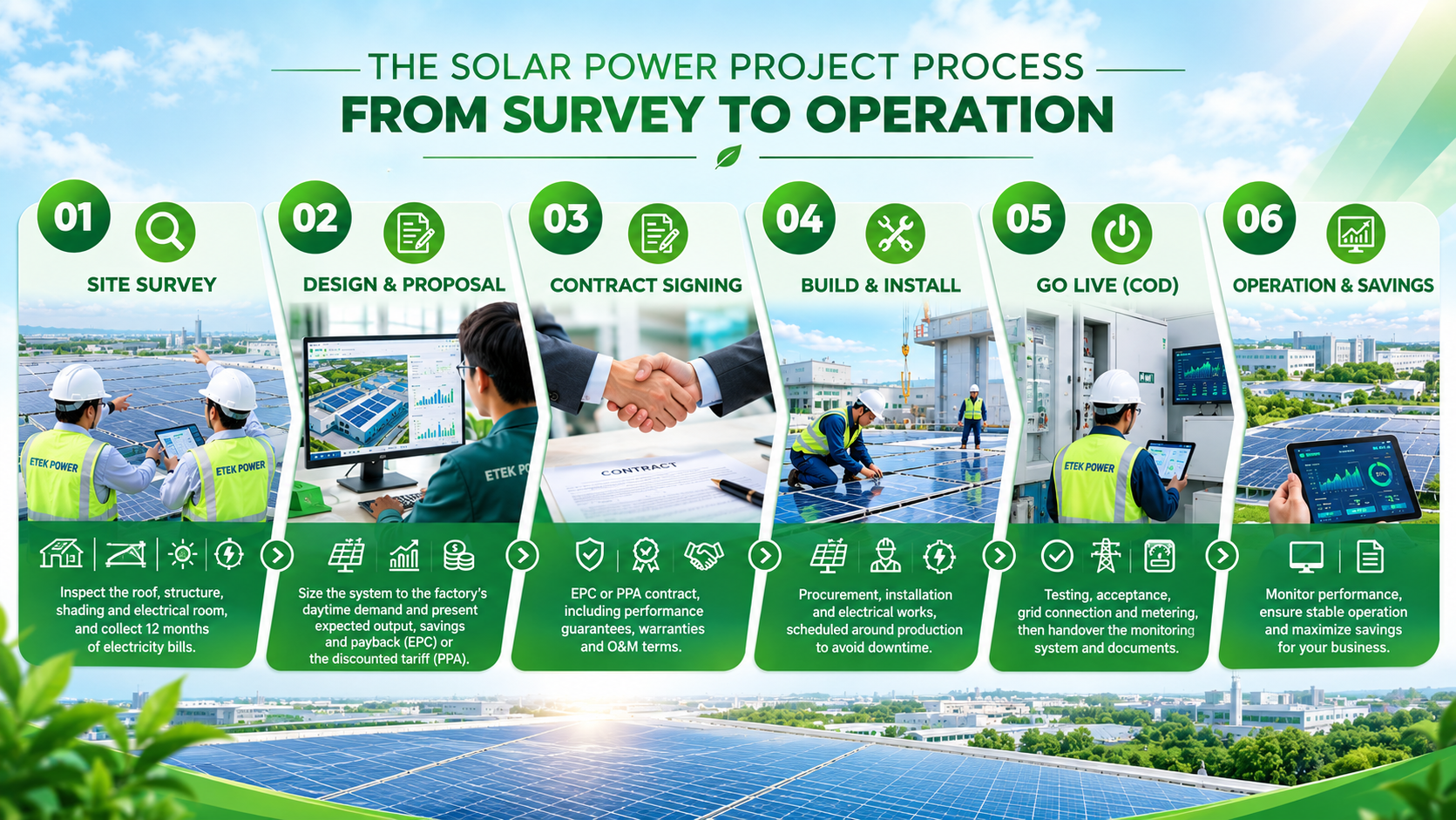
How does a rooftop solar project run?
A typical rooftop solar project at a factory runs in five steps. The time from contract signing to commercial operation is usually 45–90 days, depending on system size and local permitting.
- Site survey: ETEK Power engineers inspect the roof, structure, shading and electrical room, and collect 12 months of electricity bills.
- Design and proposal: the team sizes the system to the factory’s daytime demand and presents expected output, savings and payback (EPC) or the discounted tariff (PPA).
- Contract signing: EPC or PPA contract, including performance guarantees, warranties and O&M terms.
- Build and install: procurement, installation and electrical works, scheduled around production to avoid downtime.
- Go live (COD): testing, acceptance, grid connection and metering, then handover of the monitoring system and documents.
Documents to prepare for the first survey: 12 months of EVN electricity bills with time-of-use breakdown, architectural and structural drawings of the factory, single-line diagrams of the low- and medium-voltage systems, and the layout of the transformer station and main switchboard.
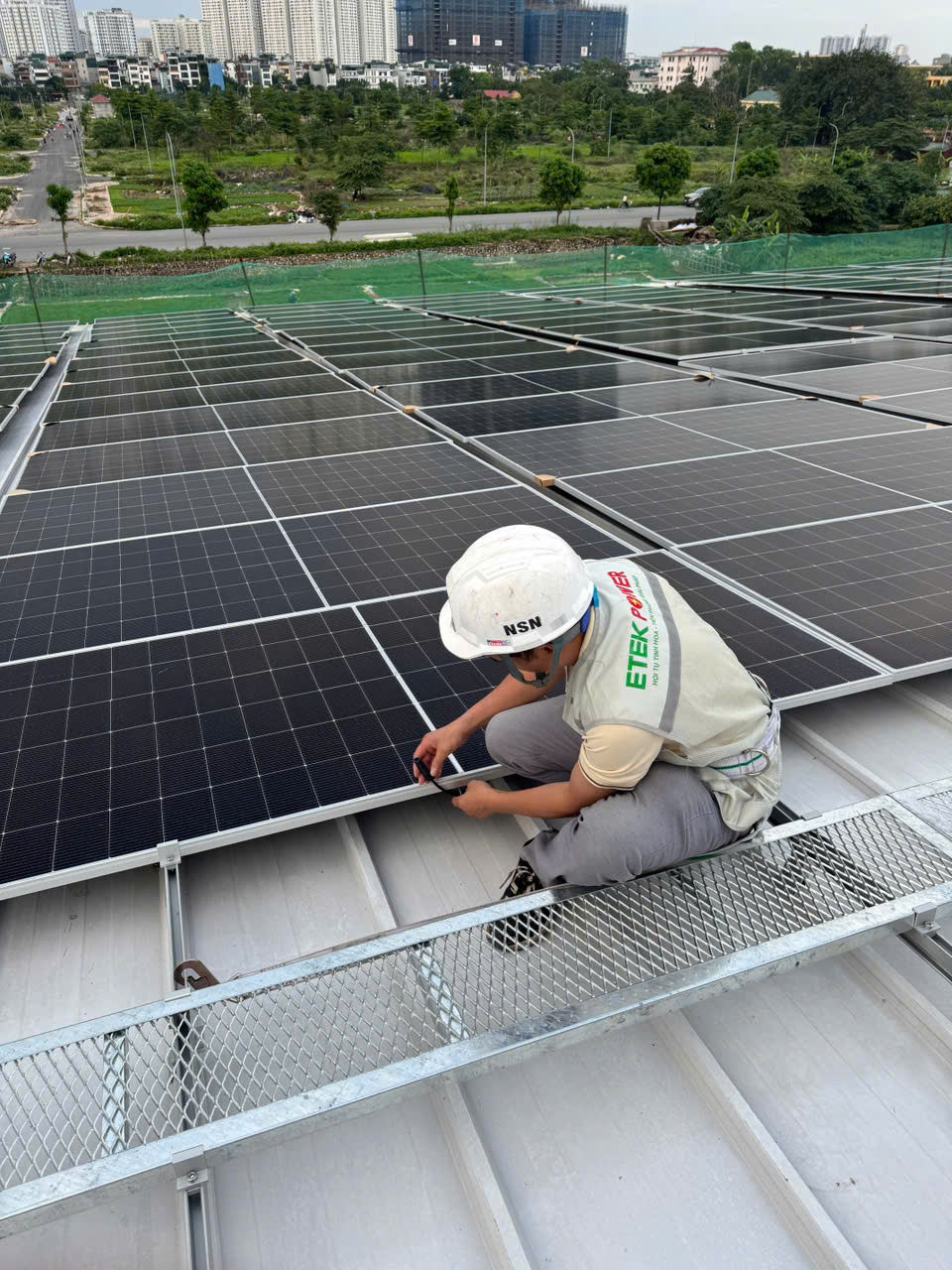
Selected projects
ETEK Power has delivered rooftop solar and BESS projects for steel, food processing, textile and industrial clients across Vietnam, with more than 25 MWh of battery storage deployed.
| Project | Type | Capacity | Location |
|---|---|---|---|
| Tan Dung Steel (in Vietnamese) | Rooftop solar | 461 kWp | Vietnam |
| Huu Nghi Food (in Vietnamese) | Rooftop solar | 928.8 kWp | Bac Ninh |
| Textile manufacturer | Rooftop solar, 1,320 × 725 Wp modules | 957 kWp | Phu Tho |
| Utility-scale BESS (in Vietnamese) | Battery energy storage | 5 MW / 10 MWh | Long An |
| VIPACO | Battery energy storage | 5 MWh | Vietnam |
Each project page includes system specifications and site photos. Detailed references and performance data are available on request for qualified enquiries.
Why choose ETEK Power?
- Solar and storage under one contract. ETEK Power designs rooftop solar and BESS together, so the system covers both daytime demand and the evening peak.
- Both financing routes. Factories can choose self-investment (EPC) or a zero-capex PPA with a renewable energy investor, with ETEK Power as the technical EPC partner.
- Sized to real demand. Systems are sized from the factory’s time-of-use load profile, not only from roof area, to avoid paying for surplus power that cannot be used.
- Safety-certified storage. ETEK Power’s BESS uses semi-solid LFP cells certified to IEC 62619, UL 1973, UL 9540A and UN 38.3.
- Local team with group backing. ETEK Power is based in Hanoi and belongs to Tan Phat ETEK Group, with 27 years in Vietnam’s energy and industrial sector.
Request a free rooftop solar assessment
How much could your factory save with rooftop solar and storage? Send us 12 months of electricity bills and your factory drawings. ETEK Power’s engineers will size the system to your actual demand and compare EPC and PPA side by side, in a one-page summary for your management team.
| Contact | Details |
|---|---|
| Company | ETEK Power Energy Co., Ltd. (Công ty TNHH Năng lượng ETEK Power) |
| Hotline | +84 947 137 388 |
| [email] | |
| Address | 189 Phan Trong Tue, Thanh Liet, Hanoi, Vietnam |
| Website | etekpower.vn/lien-he |
Call +84 947 137 388 or send your enquiry through etekpower.vn/lien-he to book a free site assessment.
Frequently asked questions
What does a rooftop solar EPC contractor do? A rooftop solar EPC contractor handles engineering, procurement, construction and commissioning of a solar system under one contract, delivering a system that is grid-connected and producing power.
How much can a factory in Vietnam save with rooftop solar? Under self-investment (EPC), almost every solar kWh used on site replaces grid power at around 1,833 VND/kWh for 22–110 kV manufacturing customers in normal hours. Systems typically pay back in about 4–5 years.
Can a factory install rooftop solar in Vietnam with no upfront cost? Yes. Under a rooftop PPA, an investor funds the whole system and the factory buys the solar power at a discount to the EVN tariff, typically 2–30% depending on region, voltage level and offtake commitment, for 15–20 years.
Can a factory sell surplus solar power to the grid in Vietnam? Yes. Decree 243/2026/ND-CP allows up to 50% of rooftop solar output to be sold as surplus, including solar energy stored in a battery system.
Does rooftop solar in Vietnam count toward RE100? Yes. On-site self-generation and on-site physical PPAs are recognised by RE100 and are exempt from its 15-year commissioning limit.
How long does a rooftop solar project take? The time from contract signing to commercial operation is typically 45–90 days, depending on system size and local permitting.